Solana Airdrop Farming: From Speculation to Professional Infrastructure (2026 Edition)
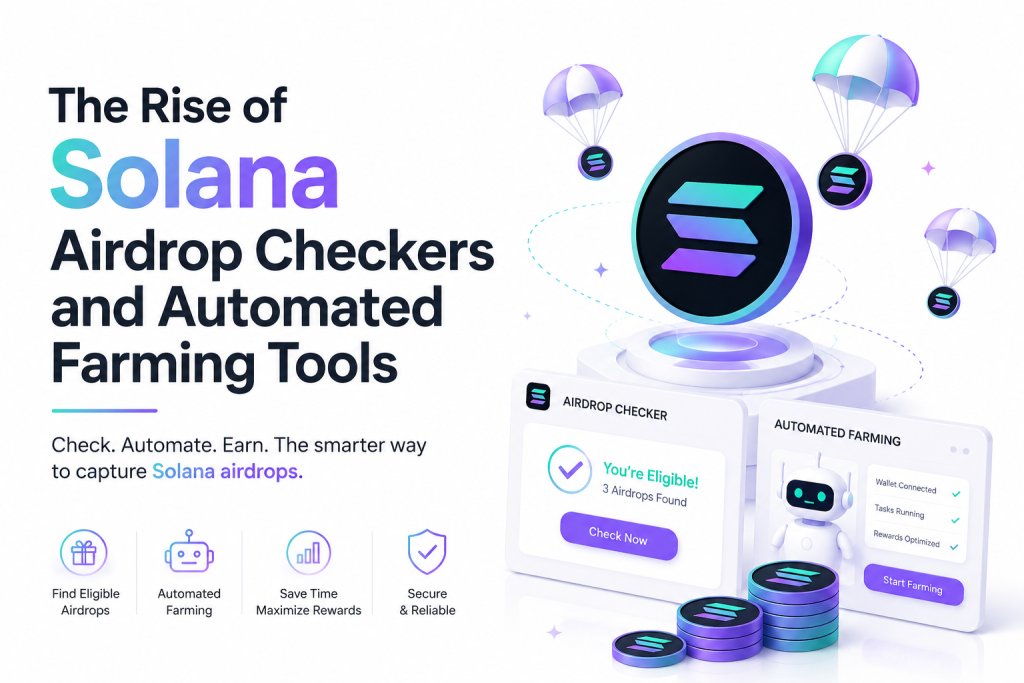
In early 2026, one of the fastest-growing sectors in Web3 wasn’t memecoins or AI agents—it was the “farming stack.” This refers to the micro-industry of tools designed to optimize, automate, and protect on-chain activity.
The shift is clear: Solana has transformed airdrop farming from a “high-gas gamble” on Ethereum into a high-throughput, low-cost operational business.
The Solana Advantage: Why the Strategy Changed
On Ethereum, farming dozens of wallets is a losing game; gas costs alone can evaporate margins. On Solana, where transactions cost fractions of a cent, users scaled from 1 to 500+ wallets.
| Feature | Ethereum Era | Solana Era (2026) |
| Transaction Cost | $5–$80 | < $0.01 |
| Scalability | Limited | Extreme |
| Farming Strategy | Manual | Script-friendly / Agentic |
Source: Compiled from industry trends and market analysis by Earnpark and Proxies.sx (2026).
The New Farming “CRM”
Airdrop checkers were the first wave, but they have rapidly evolved into lightweight CRM systems for on-chain identity. Modern Solana farming dashboards now provide:
-
Cluster Analytics: Mapping wallet funding paths to prevent “linked wallet” disqualification.
-
Behavioral Entropy: Simulating non-linear, human-like activity patterns.
-
Risk Scoring: Real-time warnings on whether a wallet is flagged by Sybil-detection algorithms (e.g., Trusta Labs, Streamflow).
The Real Battleground: Sybil Detection vs. “Organic” Simulation
Solana’s low-fee environment created a paradox: it is ideal for real users, but also the easiest place to spam. By 2026, protocols have responded with aggressive, AI-powered Sybil filtering.
The game is no longer “generating volume”—it’s “generating credibility.”
Top-tier farmers are now using advanced automation to randomize:
-
Timing: Avoiding synchronized spikes in activity (e.g., all wallets acting at 9:00 AM UTC).
-
Pathing: Ensuring wallets interact with diverse protocols in non-repetitive sequences.
-
Economics: Maintaining varied token balances and NFT holding durations.
Note: Data from Streamflow indicates that Sybil-resistant designs—such as rewarding “costly-to-fake” behaviors over time—are becoming the industry standard to prevent “dumping” behavior, which historically saw 50-70% of tokens sold within 30 days of airdrops (Source: Streamflow, 2026).
The “Gig Work” Economy
Airdrop farming has shed its “speculative” label and become digital gig work. Small teams now manage clusters of wallets using:
-
VPS Automation: Running farming schedules 24/7.
-
Browser Isolation: Ensuring distinct “fingerprints” for every wallet.
-
AI Scheduling: Letting agents execute complex, long-term yield strategies without manual input.
The Verdict: Where Web3 is Heading
The rise of Solana’s farming stack confirms a broader trend: Crypto is moving from speculation-first to infrastructure-first.
Users are no longer just “hunting” for airdrops; they are optimizing systems. The next phase won’t be about who has the fastest bot, but who has the most sophisticated AI-assisted on-chain identity. As these farming tools become more advanced, the line between an “organic human user” and an “optimized autonomous agent” is disappearing entirely.
Quick FAQs for the 2026 Landscape
-
Are farming tools still profitable? The “easy money” phase is over. Profits now rely on operational excellence—minimizing Sybil risk and maximizing interaction quality—rather than sheer transaction volume (Source: Zipmex/Earnpark market analysis, 2026).
-
What is the biggest risk? Sybil filtering. Projects now use graph analysis to trace funding back to central exchanges. If your automation is too predictable, your entire wallet cluster may be disqualified before the snapshot (Source: Proxies.sx).
-
What should I focus on? Interaction breadth. Diversifying activity across DEXs (like Jupiter/Kamino), lending platforms, and RWA (Real-World Asset) protocols is currently the most effective way to signal that you are a genuine participant (Source: Solana Foundation Ecosystem Roundup, May 2026).